
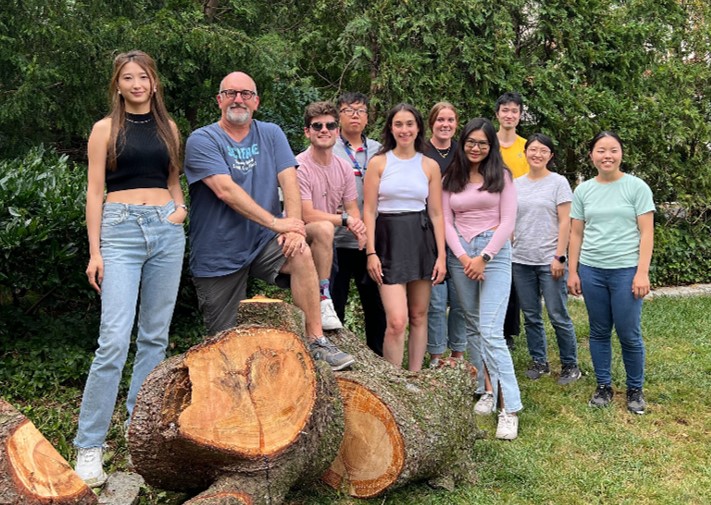
Welcome to the Hammer Laboratory.
The main research areas of the Hammer lab are: Cell Adhesion and Motility & Protocell Engineering.
Cell adhesion. Our primary focus has been on the dynamics of adhesion mediated by blood-borne cells in the microvasculature. This type of adhesion is ubiquitous in physiology – it is displayed by leukocytes to enter tissues during inflammation, stem cells to home to bone marrow to regenerate tissues and during transplants, and T-cells which regulate the adaptive immune response. To understand adhesion, we have developed a suite of computational techniques collective called Adhesive Dynamics that allow us to model the adhesion of cells to cells and to surfaces. Our current efforts are focused on developing AD algorithms in which we embed signal transduction networks within cells to show how the outside-in flow of chemical information leads to intermolecular conversions that result in changes of adhesion. Our immediate interest is in applying these insights to the design and function of CAR T-cells as effective killers of tumor cells upon cell-cell contact.
Cell Motility. We are using traction force microscopy (TFM) to image the forces that many immune cells exert during chemotaxis and chemokinesis. We have found that neutrophils exert their largest stresses in the rear and exert larger forces during chemotaxis than chemokinesis. In contrast, dendritic cells use filopodia to pull from the front. Using CRISPR-Cas9 deletion, we are now exploring how the internal molecular machinery of these cells is related to the force generation during migration.
We are studying a curious phenomenon where immune cells, such as T-cells, crawl upstream against the direction of flow on surfaces that express ICAM-1. Upstream migration is mediated by the receptor LFA-1. We have shown that other cell types – including stem cells and neutrophils – can display upstream migration. Our immediate interest is in using CRISPR-Cas9 to identify the key controllers of upstream migration and to use TFM to measure the traction stressed during upstream migration.
Protocells. We have extended the theme of cell mimicry to make novel cell-like materials (protocells) from polymers, dendrimers, and proteins. We also have recently shown that we can build autonomous, cell-motile protocells by entrapping enzymes within polymer vesicles, or by attaching enzymes to the surface of capsules. When fed a substrate, we can induce vesicles to crawl on surfaces, owing to the force generated by enzymes, which is sufficient to break weak adhesive interactions; we can also induce capsules to stream in solution. We are now inducing directional motion of capsules in gradients of substrate, and exploring how asymmetry can induce enhanced motion of capsules.
We are also designing protein condensates which can serve as membraneless organelles within these protocells and working on various ways of sequestering and releasing molecules from condensates on cue, such as with light. We are working to sequester active enzymes within these membraneless organelles and exploring how to use condensates as organelles to sequester and release active biological agents within cells to control cell behavior, such as motility, from within.
 Hammer Laboratory